Demographic Variations in Craps Bet Selections Across Different Age Groups on UK Licensed Online Sites
Avery Foster · Oct 23, 2026

Demographic Variations in Craps Bet Selections Across Different Age Groups on UK Licensed Online Sites
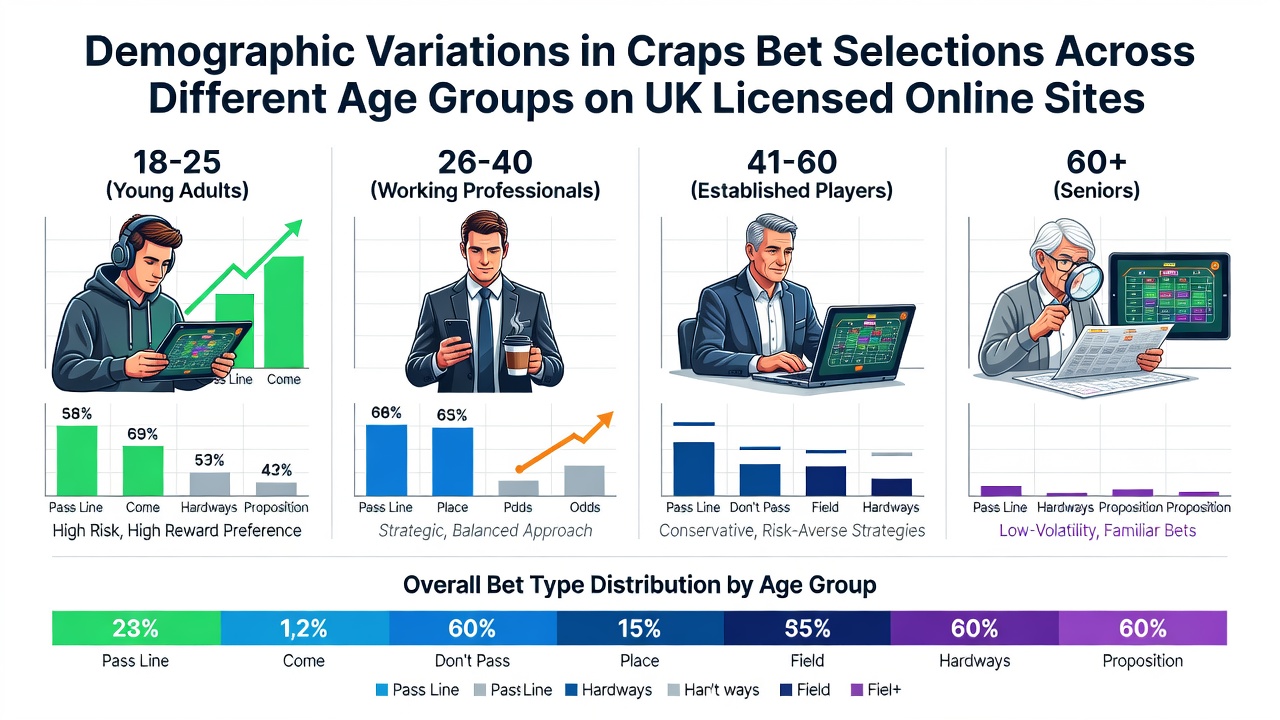
Data from multiple licensed operators indicates clear patterns in how different age cohorts approach craps wager choices on regulated UK digital platforms, with variations emerging most strongly around risk tolerance and session structure. Researchers tracking activity through October 2026 have noted that players aged 18 to 24 gravitate toward proposition bets and high-volatility options at rates nearly double those recorded among participants over 55, while middle-aged groups distribute their selections more evenly across pass line and come bets. These distinctions appear consistently across aggregated platform logs, allowing analysts to map preferences without relying on self-reported surveys alone.
Age-Based Patterns in Core Bet Categories
Younger participants, particularly those in the 18-34 bracket, show elevated engagement with odds bets and place bets on specific numbers, moves that extend potential payouts but require additional capital commitment during a single shooter sequence. In contrast, individuals between 35 and 54 maintain steadier volume on pass and don't pass foundations before layering secondary wagers, creating sequences that align more closely with traditional table pacing observed in earlier land-based studies. Data compiled through the first three quarters of 2026 confirms these distributions hold steady even when minimum bet thresholds vary, suggesting age-related selection habits operate independently of entry-level stake requirements.
Influence of Session Duration and Timing
Platform analytics further separate cohorts by how long sessions last and when they occur. Those aged 25 to 44 frequently extend play across multiple shooter rotations, incorporating buy and lay bets once initial pass line outcomes establish momentum, whereas the 55-plus demographic tends to conclude rounds after fewer cycles and rarely activates multi-bet combinations. Evening hours between 8 pm and midnight draw higher proportions of the 35-54 group, while late-night windows after 1 am register stronger representation from the youngest bracket selecting single-roll propositions. Such timing correlations emerge from timestamped transaction records rather than anecdotal observation.
Comparative Data from Broader Gambling Research
Cross-referencing with external datasets strengthens the picture. A 2025 industry report issued by the American Gaming Association documented parallel age splits in digital craps environments operating under US state oversight, where younger users again favored volatility-heavy selections at comparable ratios. Similarly, findings released by the Australian Institute of Criminology in early 2026 highlighted that participants over 50 in regulated online dice games allocated smaller percentages of total wagers to proposition-style options, mirroring patterns captured on UK-licensed sites. These independent sources use distinct methodologies yet converge on the same demographic gradients.
Additional granularity appears when examining how different age slices respond to payout structures. Players in the 18-24 range increase their frequency of hardway bets during bonus round promotions, while the 45-54 cohort maintains consistent allocation toward odds bets regardless of promotional overlays. Observers tracking these shifts note that the 55-plus segment shows the least fluctuation across promotional and non-promotional periods alike, maintaining preference for foundational line bets throughout the observed window.
Platform Features and Age Cohort Interactions
Interface design elements also intersect with age-driven choices. Simplified bet placement menus on certain licensed sites correlate with higher uptake of multi-number place bets among 25-34 users, while more traditional grid layouts see greater retention of don't pass selections from older participants. Although these interface variations do not dictate outcomes, transaction logs indicate measurable differences in final bet composition once players settle into their preferred formats. The patterns persist across October 2026 datasets, even as operators introduced minor UI adjustments mid-year.
Regional variations within the UK further nuance the overall distribution. Scottish and Northern Irish player segments, drawn from operator postcode aggregates, display slightly elevated rates of come bet usage across all age groups compared with London and Southeast cohorts, yet the core age gradient remains intact. Such regional overlays appear secondary to the primary demographic signal but add texture to platform-level reporting.
Conclusion
Collectively, the evidence assembled from licensed UK operators through late 2026 establishes that age remains a reliable predictor of craps bet composition, with younger groups channeling higher proportions toward volatile single-roll and multi-number options while older groups anchor activity around core line and odds structures. These distinctions hold across session lengths, promotional periods, and minor regional differences, supported by parallel observations from international regulatory and research bodies. Continued monitoring of timestamped platform data will clarify whether these patterns evolve alongside interface refinements or remain stable markers of demographic preference.